


The price is indicated per hour of work of a setup specialist
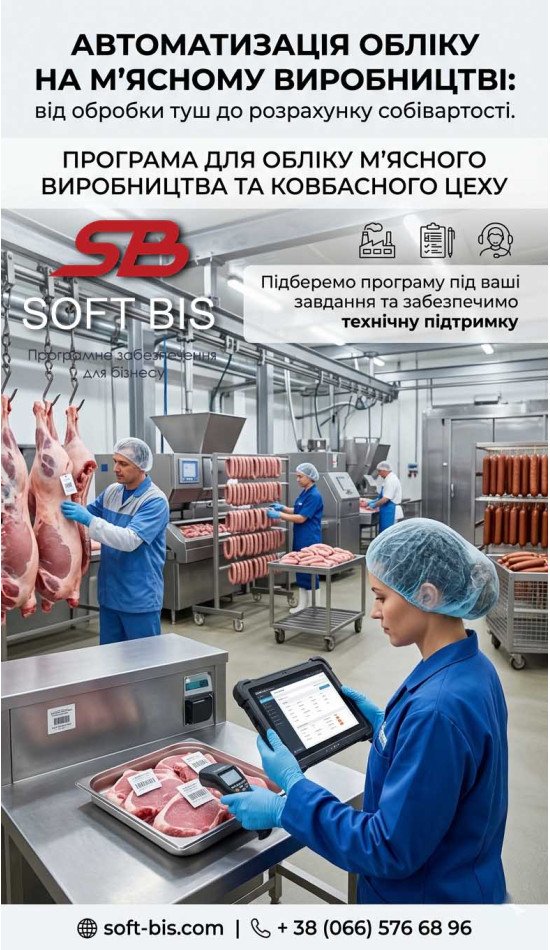
Accounting in meat production: how to restore order in a sausage workshop
Managing meat production is always about working with nuances. The weight of raw materials is constantly changing: meat loses moisture during storage, butchering yields different proportions of flesh and bone, and the shelf life of finished sausages or delicacies does not allow the product to remain in the warehouse for long.
To prevent business losses and for the manager to see real profit, a reliable automation system is needed. In this article, we will analyze how to build proper accounting "without a headache".
From procurement to the counter: key stages
1. Raw material receipt and veterinary control
It all starts with the arrival. It is important that raw material (meat) accounting is conducted strictly: receipt is recorded by weight (kg) and amounts. In the accounting system, meat is received under account 10 "Materials".
Important: The meat supplier must provide veterinary certificates (forms No. 1, 2, 3, 4). Without these documents, control of incoming raw materials is impossible, and the enterprise's operation will be illegal.
2. Butchering and production
This is the most critical stage, which is reflected in account 20. For the program to understand where the beef carcass went, the following are used:
Butchering reports: they record how much flesh, bones, and fat were ultimately obtained.
Production report per shift: this document automatically writes off raw materials from the warehouse and receives finished products.
3. Accounting for losses and natural wastage
Meat is a tricky product. During freezing, storage, and butchering, weight loss is inevitable. In the program, it is necessary to set up automatic write-off of losses according to approved norms. If this is not done, the balances on paper will always be greater than in reality.
4. Finished goods warehouse
Finished sausage or semi-finished products go to account 43. Here, detail is important: records are kept by product type, specific storage locations, and, most importantly, by shelf life. To move goods from the workshop to a store or another warehouse, internal movement invoices are used.
5. Cost calculation
For the business to be profitable, the program must account for more than just the cost of meat. To accurately calculate the cost, it is important to correctly allocate indirect expenses — staff salaries, transportation services, and rent — to each unit of output.
Why choose Soft Bis?
We understand that there is no universal template. One workshop may only need simple warehousing, while another requires a full cycle with profitability analysis.
Our approach:
- 1. Individual selection: We do not impose unnecessary things, but select the program specifically for your tasks.
- 2. Turnkey setup: We will configure butchering reports, wastage norms, and reporting forms.
- 3. Ongoing support: We do not abandon clients after the sale. Our specialists are always in touch to update the program or train new employees.
A simple solution for a sausage workshop begins with choosing the right partner. With "Soft Bis", your accounting will be transparent and your production efficient. More useful information and tools for business can be found on the website pro1C.org.ua.
Q&A
In which account is production recorded?
The main accounting of production costs is kept in account 20 ("Primary production").
What documents must the meat supplier provide?
In addition to standard invoices, the supplier must provide veterinary certificates (forms No. 1, 2, 3, or 4) and quality certificates.
What type of accounting is used in the production sector?
Production accounting (as part of managerial accounting) and general financial accounting, focused on cost calculation and work-in-progress control, are used.
What are the three main types of accounting?
1. Financial accounting.
2. Managerial accounting.
3. Tax accounting.
- WhatsApp: USA +38 (066) 576 68 96
 soft_bis
* Phone / WhatsApp: (Click on the number and you will be connected to a manager.) Calls are accepted Monday - Saturday from 9:00 to 21:00
- Тел: Viber +38 (066) 576 68 96
* Ask a question! Write a message. (Click on the number, the vase will connect you to the messenger) Messages can be sent 24/7
